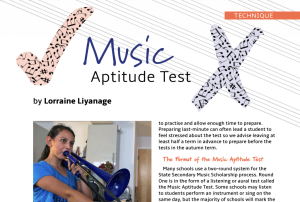
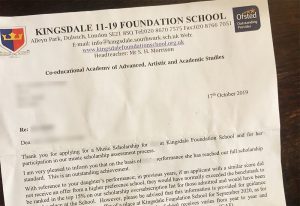
The deadline for The Gilberd School’s September 2027 music aptitude applications is now less than two weeks away.
Eligible families must submit the school’s selective-place application by Thursday 24 September 2026. The aural assessments and aptitude workshops will then take place at The Gilberd School during October.
At SE22 Piano School, we offer individual Music Aptitude Test preparation on Zoom. With limited time remaining, our aim is not to overload children with generic practice. It is to identify what the particular child needs and make the remaining preparation purposeful.
Book a focused one-to-one Music Aptitude Test lesson with Mirna.
Application reminder for parents
Applicants must live within the Colchester or Tendring areas defined in the school’s approved admissions policy.
Parents must complete two separate processes:
- submit The Gilberd School’s music aptitude application by Thursday 24 September 2026; and
- submit the appropriate local-authority Common Application Form by 31 October 2026.
Gilberd currently provides an online “Selective Places” link through its official admissions-policy page.
The school will contact applicants after receiving the form and provide an individual time and date for the October assessment. Parents should monitor their email and spam folders carefully.
Our complete Gilberd School Music Aptitude Test 2027 guide explains the eligibility rules and application process in greater detail.
What will Gilberd assess?
Gilberd’s published information describes a group aural assessment covering:
- pitch;
- rhythm;
- melody; and
- expressive intent.
Applicants will also take part in an aptitude workshop. Their scores from the aural test and workshop are combined, and candidates are placed in rank order.
There is no published pass mark. Applicants do not need formal musical training, and the current information does not describe a separate instrumental or vocal performance audition.
What should children do during the final weeks?
At this stage, preparation should respond to the child’s actual strengths and uncertainties.
One child may recognise rhythmic differences accurately but become confused when melodic material changes. Another may hear pitch confidently but lose marks through rushing, hesitation or repeatedly changing an answer.
Useful final preparation may include:
- checking which listening areas are already secure;
- identifying questions that repeatedly cause uncertainty;
- practising with unfamiliar musical examples;
- strengthening short-term musical memory;
- improving concentration and independent decision-making; and
- learning to move calmly from one question to the next.
Long practice sessions are not automatically more effective. Tired children often begin making mistakes they would not ordinarily make, which can damage confidence unnecessarily.
Short, attentive practice with a clear purpose is usually the better use of the remaining time.
How an individual lesson can help
A one-to-one lesson allows us to observe how the child listens, remembers and responds. We can distinguish between a genuine musical difficulty and a problem caused by misunderstanding instructions, rushing or second-guessing.
The lesson can then concentrate on the areas most likely to benefit from attention before October.
We do not provide Gilberd’s confidential assessment, and no tutor can guarantee a selective place. Our preparation supports the broader listening abilities, concentration and musical confidence relevant to the school’s published process.
SE22 Piano School has previously supported a Gilberd applicant who ranked 30th out of 164 candidates. You can read the family’s feedback in our Gilberd music aptitude success story.
Every applicant is different, and a previous pupil’s result cannot predict another child’s outcome. It does demonstrate what individual attention, encouragement and focused preparation can support.
Final practical checklist
Before the application deadline:
- confirm that the home address falls within the eligible area;
- complete the school’s selective-place application;
- retain the submission confirmation;
- submit the local-authority application separately;
- check email and spam folders for assessment instructions;
- avoid introducing excessive new material; and
- keep preparation calm, short and purposeful.
If your child would benefit from an objective assessment and clear priorities for the remaining weeks, book an individual Music Aptitude Test lesson with Mirna on Zoom.
We wish every Gilberd applicant the very best for October.
SE22 Piano School is independent of The Gilberd School. Admissions arrangements can change, so families should follow current instructions issued directly by the school.